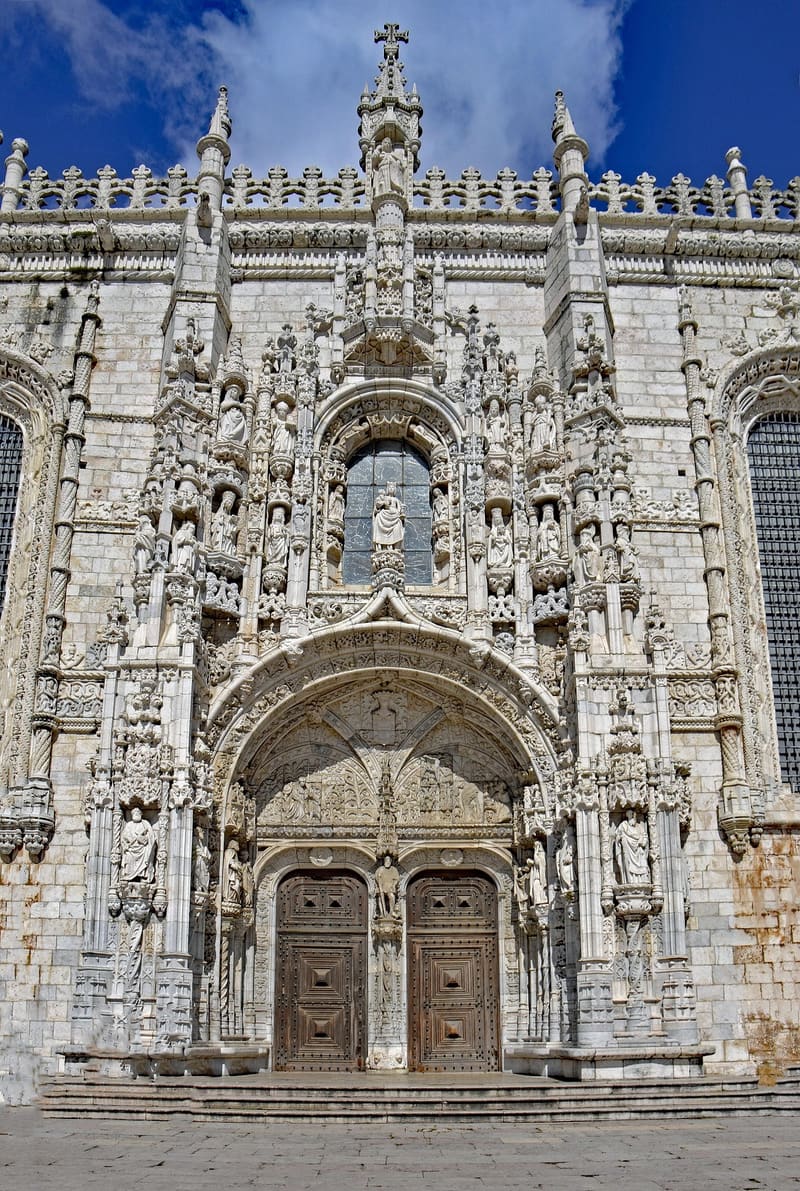
Façade of the Palácio Nacional de Mafra showing the central basilica dome, twin bell towers and 220-metre pink marble front.

King João V's vow, paid in Brazilian gold

Palácio Nacional de Mafra is the monument King João V built to thank God for an heir — 220 metres of pink Italian marble façade, 1,200 rooms, a basilica with six organs that play together, and a baroque library where the bats still come out at dusk to eat the insects that would otherwise eat the 36,000 books. UNESCO since 2019, an hour from Lisbon.

See ticket options
  • UNESCO 2019 World Heritage Site — Royal Building of Mafra
  • 1717-1755 Construction under King João V — 52,000 workers at peak
  • 6 organs Basilica's six historic pipe organs — unique in the world
  • 36,000 books Baroque library with resident bat colony

Choose your ticket

Adult (Palace)

Ages 25+ — or any age without ID for the discount

€32

  • Skip-the-line entry to the Palácio Nacional de Mafra
  • Basilica with its six historic pipe organs
  • Baroque library — 36,000 books, resident bat colony
  • Royal apartments, hunting trophy room, monastery cells
  • Mobile ticket — no printing needed
Reserve my adult ticket

Reduced (13–24)

Ages 13 to 24 — photo ID required at the gate

€17

  • Same access as the Adult ticket
  • Skip-the-line entry to the palace
  • Bring photo ID showing age 13–24
  • Mobile ticket — no printing needed
Reserve my youth ticket

Senior (65+)

Ages 65+ — photo ID required

€17

  • Same access as the Adult ticket
  • Bring photo ID showing age 65+
  • Mobile ticket — no printing needed
Reserve my senior ticket

Family bundle (2 adults · under-13s free)

2 adults — children up to 12 walk in free at the gate

€64

  • 2 adult tickets to the palace
  • Children up to 12 walk in free — no ticket needed
  • Skip-the-line for the whole group
  • One booking covers the family
Reserve the family bundle

Terraces add-on

Anyone with a palace ticket — rooftop access only

€12

  • Access to the palace rooftop terraces
  • Close-up views of the basilica dome and twin towers
  • Panorama over Mafra, the convent garden and the Tapada hunting park
  • Mobile ticket — no printing needed
Add the terraces
4.7 from 6,300 verified travellers
Visitor (TripAdvisor)
United Kingdom
“The library alone is worth the entry ticket. 36,000 books in a baroque hall that rivals Trinity College's Long Room. And the bats really do come out — staff will tell you when.”
2025-07-04
Visitor (TripAdvisor)
United States
“Way better than the National Palace at Sintra. Less crowded, more authentic, and the basilica is the most underrated baroque interior in Portugal.”
2025-05-30
Visitor (TripAdvisor)
Germany
“Lots to see — monastery cells, the hospital with adjoining kitchen, representation rooms, private rooms of king and queen, dining room, music room. Allow three hours.”
2025-04-18
  • Refund if we can't deliver
  • Cards & Apple Pay
  • Instant confirmation
  • Concierge in your language, 24/7

About Palácio Nacional de Mafra

The Palácio Nacional de Mafra was begun in 1717 by King João V of Portugal in fulfillment of a vow made to obtain an heir from his Habsburg queen, Maria Anna of Austria. Their daughter Maria Bárbara, the future Queen of Spain, had been born in 1711, and the king kept his promise on an extraordinary scale. The architect was Johann Friedrich Ludwig (João Frederico Ludovice), a German-trained jeweller and architect who had worked in Rome under Carlo Fontana and brought a late Roman baroque idiom to the Estremadura limestone hills.

Construction lasted into the 1750s, with 52,000 workers reportedly on site at peak and 1,383 documented worker deaths. The complex was funded almost entirely by the Brazilian gold cycle — the alluvial diamonds and gold of Minas Gerais that briefly made Portugal the richest crown in Europe. The basilica was consecrated in 1730 in time for the king's birthday. The 220-metre main façade encloses a 38,000 m² floor plan with 1,200 rooms, 4,700 doors and windows, two bell towers carrying a 92-bell carillon, and a single basilica dome.

Three features are unique. The first is the basilica's six historic pipe organs — built between 1792 and 1807 by António Xavier Machado e Cerveira and Joaquim António Peres Fontanes to a specification that allows all six to be played together as a single 30,000-pipe instrument. The second is the baroque library, 88 metres long, holding 36,000 leather-bound volumes from the 14th to the 19th century, where a resident colony of small bats (Pipistrellus and Plecotus species) is left undisturbed because they eat the insects that would otherwise eat the books. The third is the Tapada de Mafra — a 1,200-hectare walled hunting park behind the palace, the largest enclosed royal hunting reserve in Europe, still home to red deer, wild boar and Iberian fallow deer.

The 'Royal Building of Mafra — Palace, Basilica, Convent, Cerco Garden and Hunting Park' was inscribed on the UNESCO World Heritage list in 2019. The complex appears in José Saramago's 1982 novel Baltasar and Blimunda, which dramatizes the lives of the workers who built it and won Saramago the literary recognition that led to his 1998 Nobel Prize.
Practical information

Address
Terreiro D. João V, 2640-492 Mafra, Portugal
Hours
Wednesday to Monday 09:30–17:30 (last entry 16:30). Closed Tuesdays. Annual closures: January 1, Easter Sunday, May 1, Ascension Thursday, December 25.
Getting there
By car: 45-60 minutes from central Lisbon via the A8 motorway (exit Mafra). Free street parking around the Terreiro D. João V. By bus: Mafrense direct service from Lisbon Campo Grande to Mafra terminal (~75 min), then 5-minute walk. No direct train.
Time needed
2.5 to 3 hours for the standard palace + basilica + library route. Add 30 minutes for the rooftop terraces (separate ticket). Add a half-day if you also visit the Tapada hunting park (separate ticket, separate entrance 3 km outside town).
What to wear
Comfortable shoes — the palace floor plan is enormous and you walk continuously for 2 hours+. Smart-casual is appreciated in the basilica (it remains a consecrated Catholic church). Layers in winter — the convent and library are unheated.
Accessibility
Most of the palace ground floor and basilica are wheelchair accessible. Upper floors have some step access only. The library has a step at the threshold. The rooftop terraces are reached by stairs. Email us before your visit for the current routing.

About our service

Mafra Palace Tickets acts as a facilitator to assist international visitors in purchasing official tickets directly from Museus e Monumentos de Portugal, the official operator. We do not resell tickets — we provide a personalised booking and English-language support service. Our concierge service fee is included in the displayed price. For those who prefer to purchase directly, the official ticket site is bilheteira.museusemonumentos.pt.

Frequently asked

What are the opening hours?

Wednesday to Monday 09:30 to 17:30, with last entry at 16:30. Closed Tuesdays and on January 1, Easter Sunday, May 1, Ascension Thursday, and December 25.

Where exactly is the palace?

Terreiro D. João V, 2640-492 Mafra, in the town of Mafra in Lisbon district. About 30 km north-west of central Lisbon — 45-60 minutes by car or 75 minutes by Mafrense direct bus from Campo Grande.

Why does the palace exist?

King João V vowed in 1711 that if he was given an heir he would build a Franciscan convent at Mafra. His daughter Maria Bárbara was born that year. He kept the promise on a vast scale — the building absorbed much of the Brazilian gold cycle. Construction began in 1717; the basilica was consecrated in 1730.

Why is it UNESCO World Heritage?

Inscribed in 2019 as the 'Royal Building of Mafra — Palace, Basilica, Convent, Cerco Garden and Hunting Park'. Cited as one of the most representative monuments of Portuguese late baroque, with the unified design of palace, religious complex and royal hunting park.

What are the six organs?

The basilica's six historic pipe organs were built between 1792 and 1807 by Portuguese organ-makers António Xavier Machado e Cerveira and Joaquim António Peres Fontanes. They were designed to be played together as a single 30,000-pipe instrument — a configuration unique in the world. Occasional recitals are scheduled; we email the calendar to ticketed customers.

Are there really bats in the library?

Yes. A small resident colony of insectivorous bats (Pipistrellus and Plecotus species) lives behind the bookcases of the 88-metre baroque library, where they hunt the moths, silverfish and woodborers that would otherwise damage the 36,000 leather-bound volumes. Library staff have left them undisturbed since the 18th century. They emerge at dusk; during daytime visits you may see droppings on the floor under the bookcases.

How long does a visit take?

2.5 to 3 hours for the standard route through palace, basilica and library. Add 30 minutes for the rooftop terraces (separate add-on ticket). Add a half-day if you also want to visit the Tapada de Mafra hunting park (separate entrance 3 km outside town, separate ticket).

What is the Tapada de Mafra?

The 1,200-hectare walled royal hunting park immediately behind the palace. The largest enclosed royal hunting reserve in Europe, still home to red deer, wild boar and Iberian fallow deer. Open to visitors with separate tickets (not included in the palace ticket); the entrance is 3 km north of the palace at Portão do Codeçal.

Is there a dress code?

The basilica remains a consecrated Catholic church — shoulders covered is appreciated. Smart-casual is fine throughout the palace. No swimwear or beachwear.

Is it wheelchair accessible?

Most of the palace ground floor and the basilica are wheelchair accessible. Upper floors have some step access only. The library has a step at the threshold. The rooftop terraces are reached by stairs only. Email us before your visit for the current routing.

Can I take photographs?

Yes, throughout the palace and basilica without flash. No tripods without a permit. The library is photographable but no flash (the books are light-sensitive).

Is it suitable for children?

Yes — children love the scale, the bell tower views and the basilica. The library is a quiet space and small children should be kept calm there. Allow 2 hours with under-10s and skip the slower royal-apartment rooms.

How do I get there from Lisbon by public transport?

Mafrense (Barraqueiro Group) runs direct buses from Lisbon Campo Grande (Metro yellow/green) to Mafra terminal, roughly hourly during the day, 75 minutes. The palace is a 5-minute walk from the bus terminal. There is no direct train; trains require a change at Lisbon Sintra/Mira Sintra and are slower.

Is there parking?

Yes — free street parking around the Terreiro D. João V immediately in front of the palace. Fills on weekends from 11:00 onward.

Is there food on site?

There is a small café in the visitor centre. For lunch, the town centre 200 m south has several restaurants — try the local Mafra sausage (linguiça de Mafra) and a vinho de Bucelas from the nearby DOC.

Did Saramago write a novel about this place?

Yes — José Saramago's 1982 novel Baltasar and Blimunda (Memorial do Convento in Portuguese) dramatizes the lives of the workers who built Mafra. Saramago won the 1998 Nobel Prize in Literature and the novel is the principal literary work associated with the palace.

What language are the displays in?

Portuguese and English on all main interpretive panels. Audio guide available in EN, FR, ES, DE, IT, NL at the entrance.

Can I change my visit date?

Email us at least 48 hours before your booked slot and we'll re-book to any open slot at no charge. Inside 48 hours, same-week swaps are not always possible.

Is there a refund if I can't make it?

Tickets are issued for a specific date and are non-transferable once issued. If your plans change, reply to your confirmation email at least 48 hours before your date and we will rebook.